


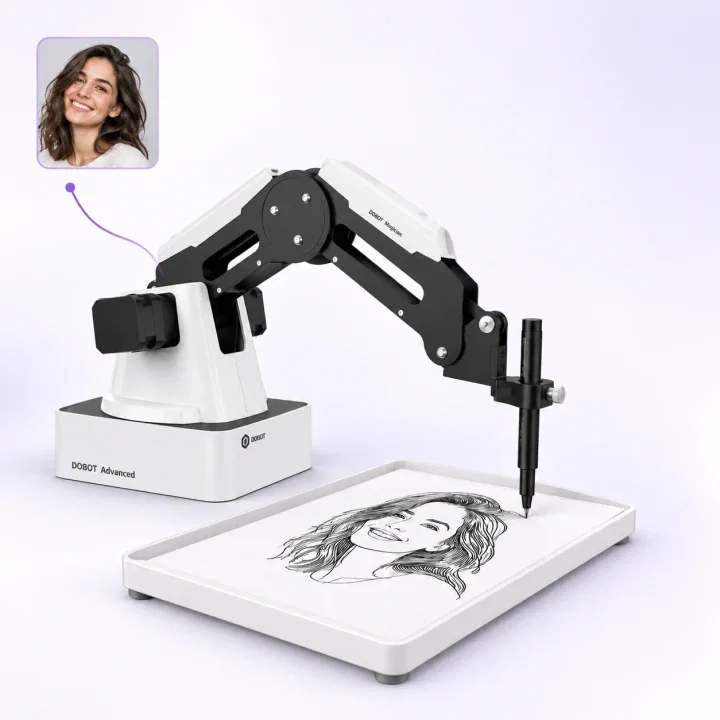
The app finds the robot by itself: you plug it in by USB and it appears as a card on the Drawing Robot page. This article lists the robots the app can drive, shows how to connect one or more of them, and explains the name, the order, the Identity button and the statuses you see on a robot card. Setting the pen height comes next, in the How Do I Calibrate the Robot? article.
- Use a Dobot Magician Lite (or an original Dobot Magician) and a Windows PC or a Mac.
- Switch the robot on and plug its USB cable into the computer.
- Open Drawing Robot. Within a few seconds the robot appears as a card under Connected Robots.
- Give the robot a name and, with more than one robot, press Identity to see which arm belongs to which card.
- A new robot shows Not configured — pen/paper calibration missing. Calibrate it, then press Ready.
Which robots work
| Robot | Works? | How to connect |
|---|---|---|
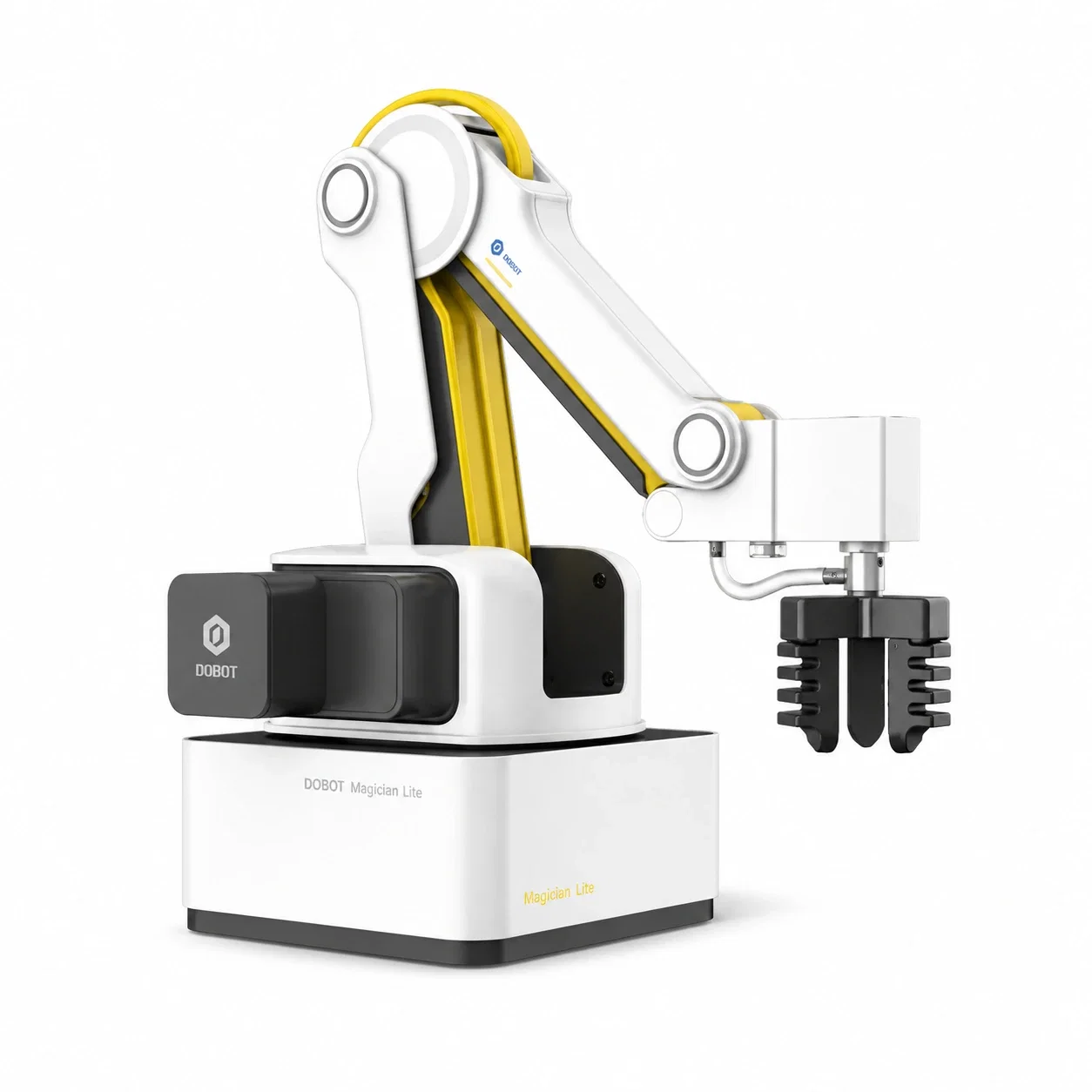
| Dobot Magician Lite | Yes. This is the robot the app is built and tuned for. | USB, either from the robot itself or through its control box. |
| Dobot Magician (the original model) | Yes. | USB, straight from the robot to the computer. |
| Any other robot arm, including other Dobot models | No. | The app does not list it. |
The figures in these articles were measured on a Magician Lite. An original Magician has a different reach, so check your paper size with Go to center before the event.
The robot is driven over a USB cable only; Bluetooth and Wi-Fi are not used.
Which computer. Robots can be driven from a Windows PC or a Mac. On an iPad, iPhone or Android device the app shows Robots cannot be driven from this device (no serial port support on this platform). and no drawing can start there.
Connect the robot
Drawing Robot → Connected Robots
- Place the robot on a flat, steady table where it will stay for the whole event.
- Connect the robot's power supply and switch the robot on with its power key. Wait until it has finished starting.
- Plug the USB cable into the computer. Use one USB cable per robot: either the robot's own USB port or the control box, not both at the same time.
- Open Drawing Robot in the sidebar. You do not choose a port. The app checks for robots every 3 seconds, and the new robot appears as a card under Connected Robots. While the app is reading the robot, the card shows Connecting….
The first time Windows sees the robot it may need a USB driver before the robot can be found. Install the driver that came with the robot, or the one on the manufacturer's support page, then unplug the cable and plug it in again.
The paper size and drawing options at the top of the page belong to the event, so choose your event before you change them. Robot cards do not need an event.
When no card appears
- Check that the robot is switched on and the cable is plugged straight into the computer.
- Unplug the USB cable, plug it in again and wait about 15 seconds.
- Close other programs that talk to the robot, such as the manufacturer's own software. Only one program can use the robot at a time.
- On Windows, check that the driver is installed.
More cases: How Do I Fix Common Robot and Drawing Problems? article.
What is on a robot card
Each connected robot has its own card. The top of the card tells you which robot it is:
| Part | What it shows or does |
|---|---|
| #1, #2, … | The card's place in the list. |
| Name box (Robot name) | Type any name, for example "Left" or "Robot A". It is saved when you leave the box. While it is empty, the robot's model name is shown. |
| ◀ and ▶ | Move the card left or right, so the cards stand in the same order as the robots on your table. |
| SN: … · Port: … | The robot's serial number and the port it is connected to. |
| Status line | What the robot is doing now (see the table below). |
| Ready | Tells the app that paper is in place and the robot may take the next drawing. |
| Identity | The arm swings left and right twice on its base, so you can see which robot this card belongs to. The pen height does not change. |
| Home | Sends the arm back to its home position. |
The rest of the card (Calibration and Paper placement) is covered in the How Do I Calibrate the Robot? article.
The name, the order and the calibration are saved on this computer for the robot's serial number. Unplug the robot and plug it in again, and the card comes back with the same name and calibration. They are not part of the event and are not copied to other devices.
Robot statuses
| Status on the card | What it means | What you do |
|---|---|---|
| Connecting… | The app has found the port and is reading the robot. | Wait a few seconds. |
| Not configured — pen/paper calibration missing | No Pen touch Z (mm) is saved for this robot yet. It takes no drawings. | Calibrate it: How Do I Calibrate the Robot? article. |
| Awaiting paper — press Ready when replaced | The robot is calibrated, but you have not confirmed the paper. | Put in a fresh sheet and press Ready. |
| Ready | The robot takes the next drawing. | Nothing. |
| Drawing… | The robot is drawing, or moving for Go to center or Mark paper corners. The only button is the red Cancel. | Wait, or press Cancel to stop it. |
| Faulted — fix the issue, then press Ready | The last drawing or move failed. The reason is shown under the status. | Fix the cause, then press Ready. |
A robot never becomes Ready by itself: after you connect it, after every drawing and after a fault, it waits until you press Ready. The app cannot see the paper.
Using two or more robots
Plug each robot into its own USB port; every robot gets its own card. With two robots, two guests can be drawn at the same time.
- Tell them apart. Press Identity on a card and watch which arm moves. Then give each robot a clear name and use ◀ and ▶ to put the cards in the same order as the arms on the table.
- Who draws next. A new drawing goes to a robot that shows Ready. If both are Ready, the one that was connected first takes it, whatever the order of the cards. If none is Ready, the drawing waits until you press Ready on one of them.
The Robots panel on the guest screen lists the robots in the order they were connected, which can differ from your card order. Go by the names, not by the numbers. Details: How Do I Use the Robots Panel During an Event? article.
If the cable comes out
When the USB cable is pulled, the card disappears within a few seconds. Plug the cable back in and the card returns with its name and calibration, in Awaiting paper; press Ready when the paper is in place.
If the cable comes out during a drawing, that drawing fails and is not started again by itself. The arm may still finish the lines it had already received, so look at the paper before you carry on. Put in a fresh sheet and press Ready.
Leaving the manufacturer's software open: it keeps the robot's port busy and the app cannot connect.
Leaving two robots unnamed: you cannot tell the cards and the rows in the Robots panel apart. Name them right after Identity.