


How long a Reflex Challenge match lasts, how big the grid is and how fast the squares light up are set in the Session → Game tab. How the game sits on screen is in two separate places: the seating layout is in the Game Screens → Input tab, and the information on the game screen and the projection view are in the Game Screens → Game tab. This article explains all of them in order and ends with ready-made setting suggestions by setup.
- A match lasts the Round length (60 seconds by default). The time is divided into four slices; in each slice the grid grows and the squares speed up.
- Choose the Grid size to suit your screen: Small on a tablet, Standard on a large touch screen, Large on a wall or projection.
- Pace decides how often the squares light up: Calm, Normal or Storm.
- If the scores end level, Overtime is played and the first hit ends the match. If you set it to Off, the match closes as a draw.
- Use Seating for players sitting face to face, and the Grid only view for projection and LIDAR.
Rules
Round time
The length of a match. The slider goes from 20 to 180 seconds in 5-second steps; the default is 60 seconds.
The time is divided into four equal slices and the game gets one level harder in each slice: the grid grows, the number of squares lit at the same time increases and new squares come more often. If you change the time, the slices lengthen or shorten with it; in a 60-second match each slice is 15 seconds, in a 120-second match it is 30. When time runs out, the one with the higher score wins.
Grid size
There are three cards; you choose one. The choice decides which sizes the grid goes through during the match.
| Option | 1st slice | 2nd slice | 3rd slice | 4th slice | Best for |
|---|---|---|---|---|---|
| Small | 3×2 | 4×3 | 5×3 | 5×4 | Tablet and small screen: few, large squares |
| Standard (default) | 4×3 | 6×4 | 7×5 | 8×5 | Large touch screen and table |
| Large | 5×4 | 7×5 | 9×6 | 10×6 | Wall and projection: many, small squares |
The card description summarizes it like this: Match it to the screen: small tiles are hard to hit on a tablet, easy on a wall.
Pace
How often new squares light up. It does not change the grid sizes, only the speed.
| Option | Description | Best for |
|---|---|---|
| Calm | Fewer tiles, more time to aim. Good for children. | Kids' events, first-time players |
| Normal (default) | The standard rhythm. | General use |
| Storm | Tiles rain down. Only for quick hands. | Tournaments, competitive players |
Overtime
Played if the scores are equal when the round time ends. The slider goes from 0 to 60 seconds in 5-second steps; the default is 15 seconds. In overtime the first hit ends the match; the grid is at its largest and fastest. If the overtime passes without a hit too, the match closes as a draw.
If you pull the slider to 0, the value shows as Off and below it reads A tied match ends as a draw.; overtime is never played.
Starting countdown
Gives the two players a moment to get ready before the first square lights up. The slider goes from 0 to 10 seconds; the default is 3 seconds. At 0 it shows Off and the match starts immediately. When the countdown ends, the text GO! appears on screen. During the countdown the grid is on screen but no squares light up.
Sound
The Game sounds switch turns the hit, countdown and ending sounds on and off. It is on in a new event. The sounds are generated inside the app; no sound file is uploaded.
How points are counted
Two players hit the same grid. Every lit square is in one player's color, and when it is hit the point is written to the owner of that color; who touched it does not matter. So hitting your opponent's color earns them a point. Hitting a dim square brings neither a point nor a penalty.
The squares are distributed evenly between the two colors: the same color lights up at most twice in a row, and the color with fewer squares left on the grid gets a better chance of lighting up. A new square lights up right away in place of the one that was hit; the grid is never empty during the match.
The score is the player's number of hits. The result screen also shows the match's fastest reaction (in milliseconds) and the total number of hits.
Setup types
Seating layout
Chooses how the two players stand in relation to the screen; it applies to the input form and the game screen.
- Side by side (default): Both read the screen the same way up. For upright screens and walls.
- Facing each other: Player 2's side is turned 180°. For screens lying flat, such as a table. The warning below says so: Use this only on a screen laid flat. On an upright screen Player 2 sees an upside-down interface.
Projection and LIDAR: Board only
The Show nothing but the grid during the game switch simplifies the game screen: the player panels and the top strip disappear and only the grid stays on screen. The remaining time is shown by a thin line on the top edge. The flow stays the same; the Welcome, Input Form, Thank You and Matches screens do not change. Use it in setups projected onto the floor or a wall and on surfaces where touch is detected with LIDAR.
While the switch is on, the slider below it sets how much of the screen the grid fills: between 40% and 100%, 92% by default. The slider only applies in this view.
Information on the game screen
| Setting | What it does | Default |
|---|---|---|
| Countdown clock | Shows the remaining time above the grid | On |
| Player names | Names on the side panels. Names only come from the input form; if the form is off, it reads Player 1 / Player 2 | On |
| Result pause | How long the result stays on the game screen when the match ends, 400–6000 ms | 2000 ms |
Recommended combinations
The following are suggestions to start with; change them to suit the venue and the guests.
| Setup | Settings | Why |
|---|---|---|
| Tablet or small touch screen | Small grid, Normal pace, 60 seconds | The squares stay large enough to hit comfortably with a finger |
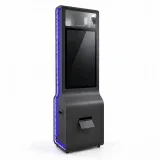
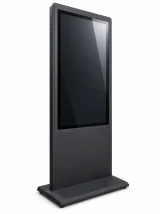
| Large touch screen, upright | Standard grid, Normal pace, Side by side | The default setup; the two players stand side by side |
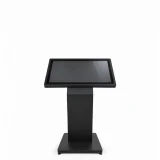
| Tabletop screen lying flat | Standard grid, Facing each other seating | The two players sit facing each other, each reads their own panel the right way up |
| Wall or floor projection, LIDAR | Large grid, Grid only on, 90 seconds | Many squares on a wide surface; the panels do not cover the surface |
| Kids' event | Small or Standard grid, Calm pace, overtime Off | Fewer squares and time to aim; the match can also end in a draw |
| Trade-show booth, long queue | 30–45 seconds, overtime 10 seconds, countdown 3 seconds | Matches are short, the queue moves fast |
| Tournament | 90 seconds, Storm pace, overtime 15 seconds | Time for a gap to open; a draw is settled by overtime |
All settings together
| Setting | Where | Range | Default |
|---|---|---|---|
| Round length | Session → Game | 20–180 s | 60 s |
| Grid size | Session → Game | Small / Standard / Large | Standard |
| Pace | Session → Game | Calm / Normal / Storm | Normal |
| Overtime | Session → Game | 0–60 s, 0 = Off | 15 s |
| Start countdown | Session → Game | 0–10 s, 0 = Off | 3 s |
| Game sounds | Session → Game | On / Off | On |
| Seating | Game Screens → Input | Side by side / Facing each other | Side by side |
| Show nothing but the grid during the game | Game Screens → Game | On / Off | Off |
Choosing the Large grid on a tablet: in the last slice there are 60 squares and they shrink too small to hit with a finger.
Choosing the Facing each other layout on an upright screen: Player 2 sees the interface upside down.
Forgetting Grid only on on a touch screen: guests cannot see the score and names during the game.
Setting Overtime to Off and waiting for a winner: if the scores end level, the match closes as a draw.
Leaving the Storm pace on at a kids' event: the squares light up too fast to keep up with.
Related topics
How to Get Reflex Challenge Ready for an Event? What Does the Guest See? One Game from Start to Finish How to Collect Names and Consent from Players? How to Change the Texts of the Guest Screens? How to Set the Colors, Logo and Background? Troubleshooting: Common Problems and Their Solutions