


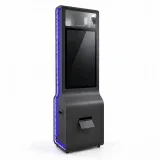
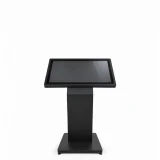
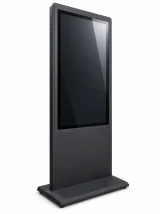
Tic Tac Toe is a single game, but it is played in three different setups: side by side on an upright touch screen, facing each other on a screen laid flat on a table, and by throwing a ball at a LIDAR wall. Two settings decide the setup: Seating and Play with a ball (LIDAR). On top of that, you set the pace of the game with rules such as the board size, the series and the move time. This article explains the three setups, where they are chosen, what they change on the guest screen, and the recommended combinations for common scenarios. The rules are explained one by one in the article How to Set the Game Rules?
- Two settings decide the setup type: Game Screens → Input → Seating (Side by side / Facing each other) and Game Screens → Game → Board → Play with a ball (LIDAR).
- The ready-made values are for an upright touch screen: Side by side, ball mode off. You can run it without changing anything.
- Facing each other is only used on a screen lying on a table; Player 2's side turns 180°, the board does not turn.
- Play with a ball (LIDAR) must not stay on with a touch screen: the square a finger passes over counts as a move.
- The rules in the Session → Game tab set the pace of the game; the table below gives recommendations by scenario.
The three setups
Touch screen, players side by side
The most common setup: an upright touch screen or tablet, with the two players standing side by side in front of it. With Side by side selected (Both read the screen the same way up.), everything is the right way up; this is the ready-made value. On the input form the two cards come side by side; on the game screen the Player 1 (X) panel is on the left, the Player 2 (O) panel on the right, and the board is in the middle. A move is made by touching a square.
Tabletop flat screen, players facing each other
If the screen is laid on a table and the players sit across from each other on either side of the table, choose Facing each other (Player 2's side is turned 180°.). When you select it, this warning appears below: Use this only on a screen laid flat. On an upright screen Player 2 sees an upside-down interface. The setting is chosen in one place but applies to two screens at once:
- On the input form, Player 2's card and the consent window opened from that card turn 180°; Player 2 fills in the form from their own side. The single Cancel button below the cards stays the right way up.
- On the game screen, Player 2's panel turns as a whole: the mark, the name, the number of rounds won, the Your turn text and the move time ring.
Know what does not turn too. The board itself does not turn; X and O read the same from every direction. The round counter and series score in the top strip, the round and match end banners (wins the round, Draw, wins the match!) and the ball mode band face Player 1. Player 2 sees these texts upside down. Since the banners are brief, in practice this causes no trouble; Player 2 follows the score from the round count in their own panel.
When you make the choice in the Input tab, the right card in the preview turns right away. The preview of the Game tab does not show the turn; this is normal.
LIDAR wall: playing by throwing a ball
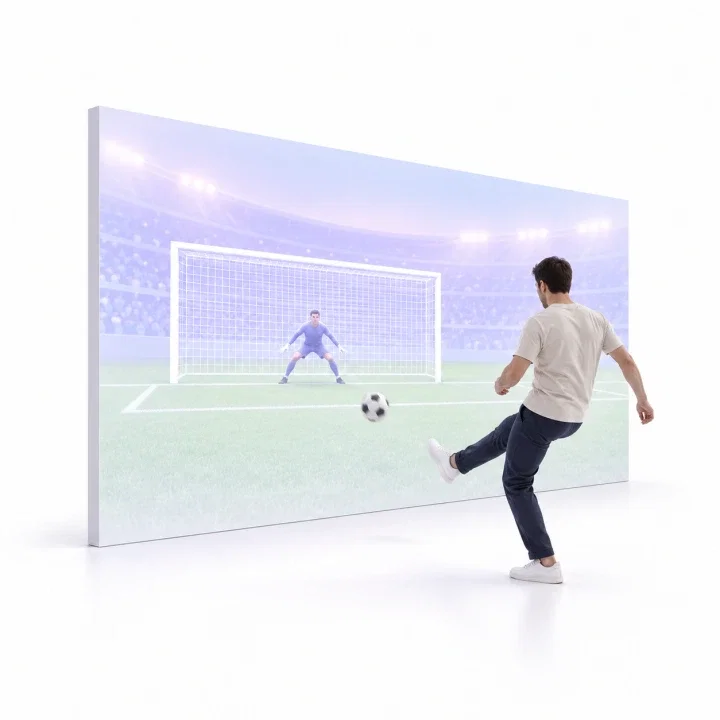
The board is projected onto a wall or a screen, and a LIDAR sensor reports a ball hitting the wall as a touch. In this setup, turn on the Play with a ball (LIDAR) switch. The difference is this: a square is chosen the moment the ball (or the pointer) comes over it; it does not wait for the touch to complete. If the ball hits between two squares, the nearest square counts. A ball landing on a filled square does nothing.
When the switch is turned on, the Lock after each throw slider appears below it: from 0.5 to 5 seconds, in quarter-second steps; the default is 2 seconds. After every accepted move, the board ignores the ball for this long; so a ball bouncing off the wall cannot make a second move on the opponent's behalf. During the lock, this happens on the guest screen:
- Both player panels stay dimmed, the move time ring stops.
- A band appears in the middle of the board: the next player's mark, name, the Your turn text and a line that shrinks until the lock ends. You change or hide the text in the Game Screens → Game → Waiting text (ball mode) row; the name is always shown.
- When the lock ends, the turn comes back in color and the move time restarts full.
When a round ends, the winning line stays on screen for at least the lock time; if Round end pause is longer, that applies. So the return of the winning throw does not become the first move of the new round.
With a new LIDAR setup, always rehearse before the event: throw a few balls, see that the bouncing ball does not make a second move, and lengthen the lock if the ball returns slowly. Also keep the move time long enough for the ball to be picked up and thrown again.
The pace of the game through the rules
The setup type says how a move is made; how long the game lasts and how close it is are decided by the rules in the Session → Game tab. Here is a summary of the options; each rule's default, limits and look on the guest screen are in the article How to Set the Game Rules?
| Rule | Options | Effect |
|---|---|---|
| Board | 3x3 (Classic), 4x4, 5x5 | A big board gives longer rounds that depend less on luck |
| Marks in a row to win | From 3 up to the side length; only on 4x4 and 5x5 | Becomes 4 by itself when you enlarge the board; do not pull it down to 3 |
| Series | Single match, Best of three, Best of five | How many wins take the match; draws use up rounds |
| Who starts | Alternating, Always Player 1, Random | Who gets the first-move advantage |
| On a draw | Counts as a draw, Replay the round | Replay at most three times, then it counts as a draw |
| Move time | 0–120 seconds; 0 = Off | While off, only the kiosk timeout closes an abandoned game |
How much of the screen the board takes up is not a rule but appearance: the percentage slider in the Game Screens → Game → Board section, from 40% to 100%; the default is 100%, that is, the largest board that fits. The player panels stay in place; only the board grows or shrinks. On a LIDAR wall leave it at 100% so that the target is big; on a tabletop choose a size both players can reach comfortably.
Recommended combinations
The following are recommendations; run it according to the length of the line and the guest profile. Settings not mentioned stay at their ready-made value.
| Scenario | Settings | Why |
|---|---|---|
| Trade show stand, quick line | Side by side; 3x3; Single match; Move time 20 s; Counts as a draw | A match ends in a minute, the line flows; an abandoned board closes by itself as the timers run out |
| Tournament, with a prize | 4x4 or 5x5 + Marks in a row to win 4; Best of five; Move time 30 s; Alternating | The luck of a single round does not decide the result, the first-move advantage changes hands, there is time to think |
| Kids event | 3x3; Move time 60 s or Off; Replay the round; Best of three | No time pressure, another chance on a draw; if you choose Off, keep Session Timeout on |
| Tabletop kiosk | Facing each other; 3x3; Best of three; Move time 20 s; Player names on | Each side plays from its own direction; Player 2, who sees the banner upside down, follows the score from their own panel |
| LIDAR wall | Play with a ball (LIDAR) on; lock 2–3 s; Move time 30 s or longer; Round end pause 4000 ms; 3x3; board 100% | The time does not run out before the ball is picked up and thrown, the bouncing ball does not count, the banner stays long enough to read from a distance |
What changes on the guest screen
| Element | Side by side | Facing each other | Ball mode |
|---|---|---|---|
| Input form cards | Both the right way up | Player 2's card and consent window turned | Unchanged |
| Player panels | Both the right way up | Player 2's panel turned | Both dimmed during the lock |
| Board | Move on touch | Move on touch; the board does not turn | Move when the ball comes over it; unresponsive during the lock |
| Move time ring | In the panel of the player whose turn it is | Same, turned for Player 2 | Stops during the lock, then restarts full |
| Top strip and banners | The right way up | Face Player 1 | The banner stays at least as long as the lock |
| Your turn band | None | None | In the middle of the board during the lock |
The top strip is hidden with the Round counter and series score switch, the names with the Player names switch; both are in the Game Screens → Game tab and apply in all three modes.
Leaving the Play with a ball (LIDAR) switch on with a touch screen: every square a finger or the mouse passes over becomes a move, and the guest says "it played without me touching it". Only turn it on in a LIDAR setup.
Choosing Facing each other on an upright screen: Player 2 sees the form and their panel upside down. On an upright screen always Side by side.
Choosing 5x5 and pulling the Marks in a row to win slider down to 3: the starting player wins almost every round. On a big board leave it at 4 or 5.
Setting Move time to Off and also turning off Event Settings → Kiosk → Session Timeout: an abandoned board stays on screen forever, the next guest cannot start.
Lowering the lock to 0.5 seconds on LIDAR, or leaving the move time at 20 seconds: the bouncing ball plays on the opponent's behalf; the time runs out and the turn passes before the ball is picked up.