





Photo booth business insurance usually starts with general liability coverage, because it is the policy venues ask to see before they let you load in. Add cover for your equipment, a written rental contract for every booking, and a clear consent step for any guest data you collect, and you have the core paperwork most new owners need before their first paid event.
This is general information, not legal, tax or insurance advice. Rules differ by country, state and city, so confirm details with a local agent, accountant or lawyer.
Register the business before you take a deposit
Registering makes insurance, banking and contracts easier. The US Small Business Administration (SBA) says your location and business structure decide how you register.
- Sole proprietor: the simplest start. Many states require a "doing business as" (DBA) filing if you use a brand name.
- LLC or corporation: registered with the state where you operate. Ask an accountant whether it suits you.
- Tax ID: in the US, an Employer Identification Number (EIN) from the IRS.
- Local licenses: cities and counties set their own rules, so check their websites and your Secretary of State site.
Outside the US, look for the same steps: a business registry, a tax number and possibly a trading license. Our how to start a photo booth business guide covers the full order.
General liability and the certificate of insurance
General liability covers third party claims: a guest trips over your cable, or a light stand scratches a venue's floor.
Venues check it through a certificate of insurance (COI) listing your insurer, policy dates and limits. Insureon notes you will likely need proof of insurance for weddings, private events and commercial properties, and cites a $1 million per occurrence limit as a common venue requirement.
Certificate holder or additional insured?
- Certificate holder: the venue receives proof that you are insured, but is not protected by your policy.
- Additional insured: the venue is added to your policy for claims tied to your event, often with exact wording.
Insurance Canopy says most venues want this before the final deposit or about 30 days before the event. Before buying, ask how quickly you can add venues and whether it costs extra.
Cover your equipment, vehicle and staff
General liability protects other people's property, not your gear.
| Coverage | What it protects | When you need it |
|---|---|---|
| General liability | Injury or property damage to others | Almost always, venues ask for it |
| Inland marine (equipment) | Your booth and gear in transit, at venues or stored off site | If you own gear worth more than you could replace from savings |
| Business owner's policy (BOP) | Liability plus commercial property in one plan | When you also keep gear or stock at a fixed location |
| Commercial auto | Vehicles used for the business | Personal auto policies may exclude business use, so check yours |
| Workers' compensation | Injured employees | Required in most states once you hire staff |
Insureon describes inland marine as cover for booths and equipment "wherever they go." Ask whether theft from a vehicle is included. Your photo booth equipment list, with serial numbers and prices, doubles as your insurance inventory.
Try AI Photo Booth Pro free for 14 days
No credit card needed. Set up your first event in minutes.
Start Free TrialYour photo booth rental contract checklist
A photo booth rental agreement writes down what was promised. Start from a template and have a local lawyer review it once. Cover these points:
- Event details: date, venue address, setup time, service hours and teardown time.
- Price and payment schedule: the package, the deposit to hold the date, and when the balance is due.
- Cancellation and rescheduling: what happens to the deposit at each notice period, plus weather and emergency terms for outdoor events.
- Overtime: your hourly rate and who approves it on the night.
- Venue requirements: floor space, a power outlet within reach, internet if you use online features, and cover for outdoor setups.
- Damage: who pays if guests damage props or equipment.
- Liability limits: what you are and are not responsible for, and that you carry insurance.
- Image rights: whether you may use event photos in your marketing.
- Guest data: who owns emails or phone numbers collected and how they are used.
- Governing law: which jurisdiction's rules apply to the agreement.
Our booking automation guide shows how to send the contract and collect the deposit in one step.

Guest privacy and consent for lead capture
Brand activations often ask the booth to collect guest emails or phone numbers. For EU events, the GDPR sets the bar. Malta's data protection authority summarizes it: consent must be freely given, specific, informed and unambiguous, given by a clear affirmative act, and you must be able to show it was given.
- Leave consent boxes unticked so guests opt in themselves.
- Ask separately for each purpose, for example "send me my photo" and "send me offers from the brand."
- Say in plain words who will receive the data and how to withdraw consent.
- Agree in the contract who keeps the data and when you delete your copy.
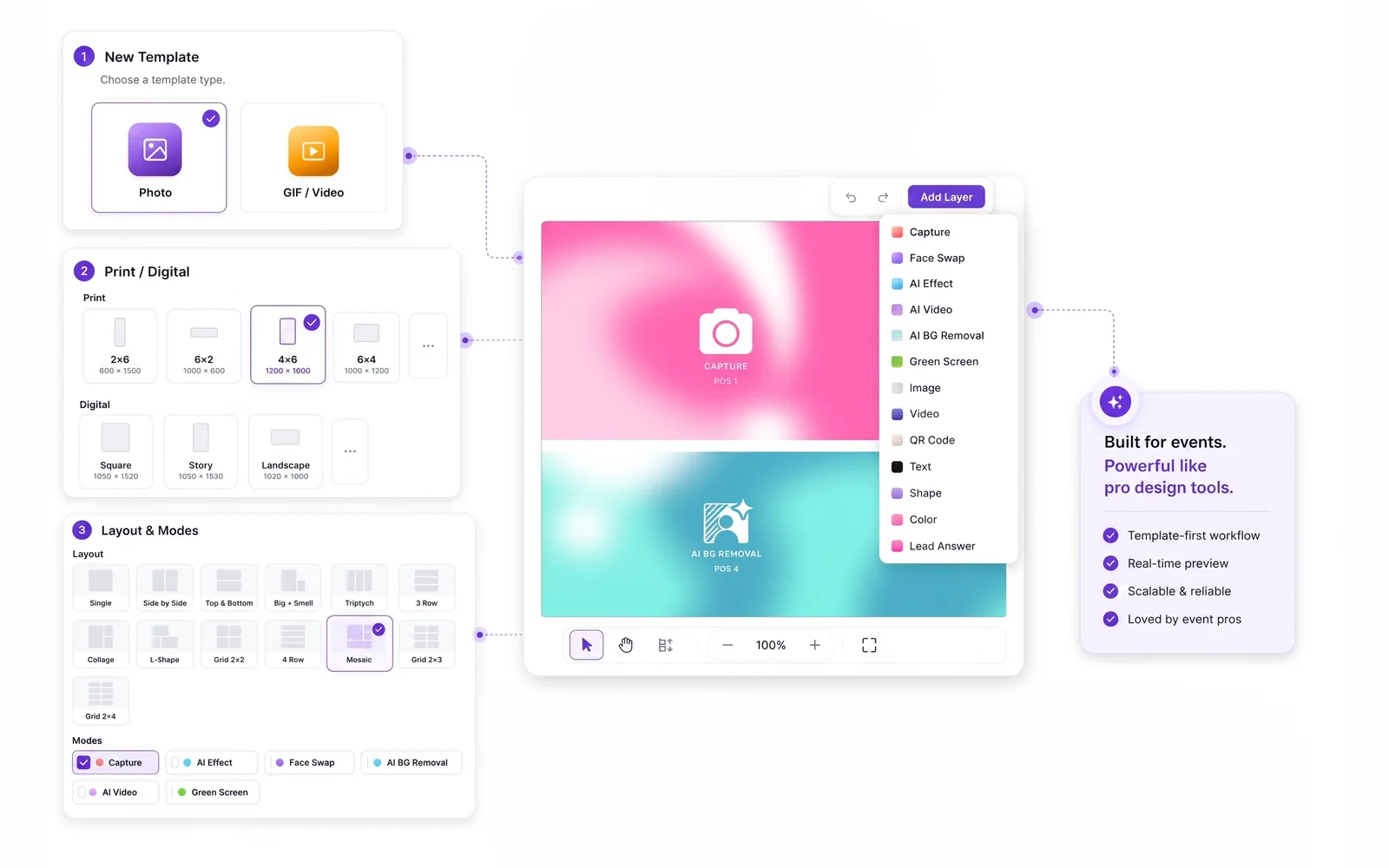
Other countries and US states have their own rules, so check where the event takes place. In AI Photo Booth Pro, lead capture forms with guest consent are part of sharing, and results appear in the online event dashboard. You still set the notices, permissions and retention that apply to you.
Sales tax and the records you keep
Whether a booth rental is taxable depends on where you work. The SBA notes sales tax rules vary by state and locality and points owners to their state Department of Revenue. Outside the US, ask about VAT or GST registration. Settle this early, because it changes your quotes.
Keep a folder per booking: contract, COI, invoices and consent records. Include insurance in your photo booth rental pricing and your photo booth business plan, alongside software at $79/month.
Worked example and printable checklist
You book a hotel wedding. The coordinator asks for $1 million in general liability, the hotel named as additional insured, and the COI two weeks before the date. You request the certificate with the exact wording, send your contract with a deposit invoice, confirm an outlet near the dance floor, and note that the couple does not want their photos in your marketing.
Tick this off before your first paid event:
- Business registered, with a DBA if you use a brand name
- Tax ID, bank account and local license checked
- General liability policy with a limit that meets venue requests
- Insurer can issue COIs and add additional insureds quickly
- Equipment (inland marine) cover with an up to date gear list
- Auto policy checked for business use
- Contract template reviewed by a local lawyer
- Deposit, cancellation, overtime, image rights and data clauses written
- Consent wording ready for any lead capture form
- Sales tax position confirmed with an accountant
One plan, unlimited events
Pro is $79/month or $699/year, for 2 devices with AI effects, face swap and AI video.
View pricingSources
- Insureon: Photo Booth Insurance (checked November 2026)
- TRUiC: Photo Booth Business Insurance (checked November 2026)
- Insurance Canopy: Event Insurance, Additional Insureds and Certificates (checked November 2026)
- U.S. Small Business Administration: Register your business (checked November 2026)
- U.S. Small Business Administration: Apply for licenses and permits (checked November 2026)
- IDPC Malta: Conditions for Valid Consent (checked November 2026)